

25.09.2026 - 10:55:00
The Joint Is the System
A grease duct is not one object. It is a few dozen connections in series — and every one of them has to do six jobs at once.
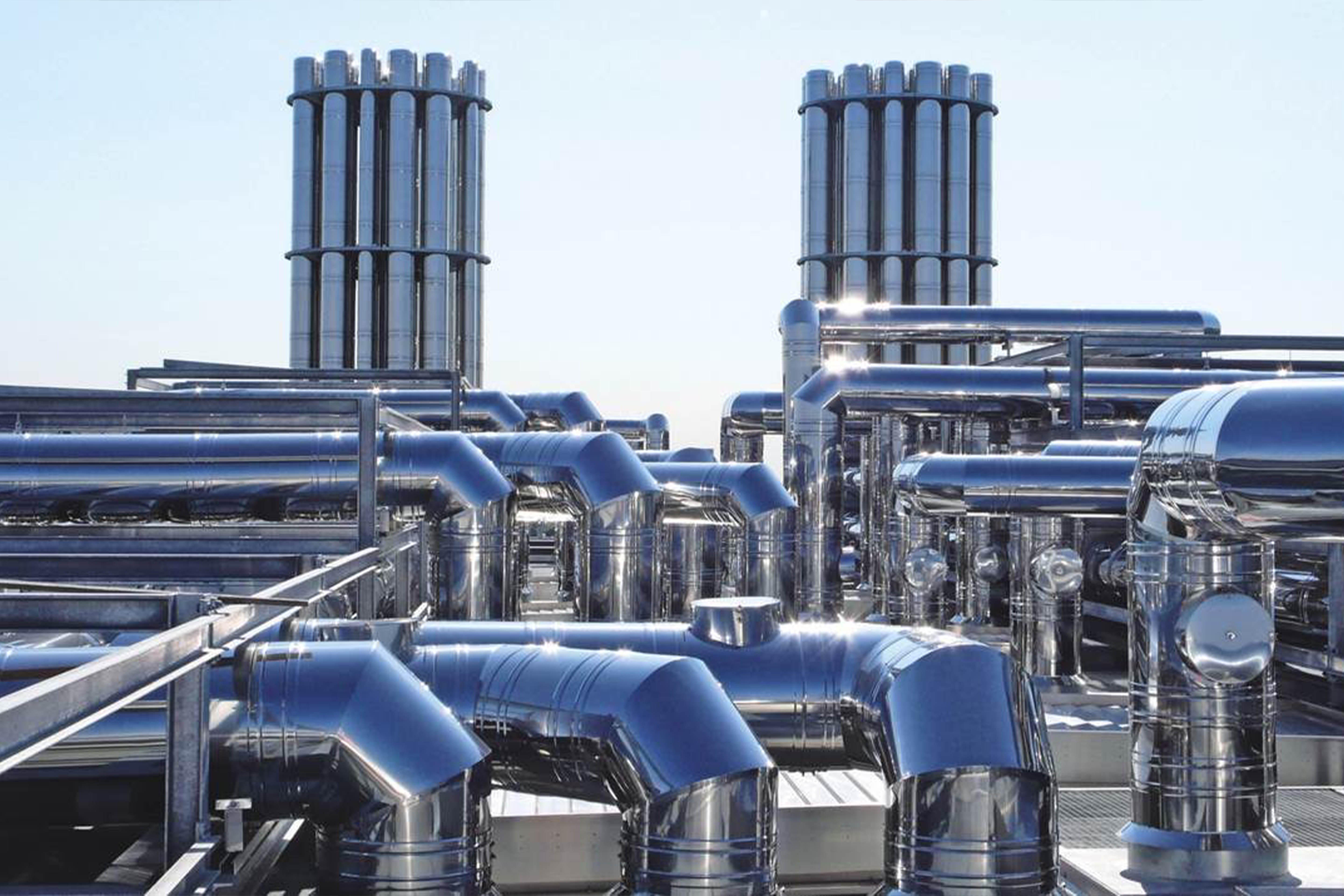
Draw a grease duct on a page and it looks like a single continuous thing: a line running from the hood collar, across the ceiling cavity, up a chase, out through the roof. One element. One line weight. One entry in the schedule.
Build the same duct and it is nothing of the kind. It is thirty or forty sections of stainless steel, and thirty or forty places where two of those sections meet. The sheet metal between the connections is the easy part. Rolled stainless ducting has been a solved problem for a long time. What the category has been iterating for decades is what happens at the joint.
The joint is where systems fail. Not in the middle of a straight run — at a connection: a weld that was rushed on a Friday, a joint that pulled apart under thermal cycling, a sealant bead that gave up in year eleven, a clamp that a cleaning crew loosened and never got fully re-tightened. Grease finds the gap. Once it is outside the duct, it is outside the fire-protected path, and everything the design assumed about that commercial kitchen exhaust assembly stops being true.
So it is worth spending a few minutes on the least-glamorous element on the drawing — and on a distinction most spec sections miss entirely. The question is not whether a joint is welded, flanged, or clamped. The question is whether the two sections engage each other before anything is asked of the seal.
What the code says about joints, and the one sentence that matters
The default in NFPA 96 is unambiguous. Seams, joints, penetrations, and duct-to-hood collar connections are required to have a liquid-tight continuous external weld. In field-fabricated construction that means carbon steel at a minimum of 16 gauge or stainless at a minimum of 18 gauge, welded continuously, with a leakage test performed before the system is concealed — a light test, a water test, or an approved equivalent, conducted in accordance with ASHRAE 154.
That is the baseline. A grease duct is, by default, a welded fabrication.
Then comes the sentence the entire listed-systems category rests on: factory-built grease duct listed in accordance with UL 1978 is permitted to incorporate non-welded joint construction in accordance with its listing.
Read that carefully, because it is doing more work than it appears to. It does not say non-welded joints are acceptable. It says non-welded joints are acceptable in accordance with the listing — meaning the only thing that qualifies a mechanical connection to carry grease is the test data behind it. The listing is not a marketing credential. It is the legal instrument that permits the joint to exist at all.
Which sets a high bar for what that connection has to prove.
Six jobs, simultaneously
Ask what a grease duct connection has to do and most spec sections answer with one word: seal. That undersells it considerably. The joint has six jobs, and they are in tension with each other.
Contain liquid, not just gas. Grease-laden vapor condenses. What runs along the bottom of a horizontal duct is liquid, and liquid finds a pinhole that air would never notice. This is why the requirement is liquid-tight rather than airtight, and why the pre-concealment test is a light or water test rather than a pressure decay test.
Hold pressure without deflecting. Exhaust systems run negative on the duct side of the fan and positive downstream of it. Static pressure at the joint is a real structural load, not a nominal one, and a connection that opens a few thousandths under pressure has stopped being liquid-tight.
Hold alignment. A joint that permits angular play produces a run that sags between hangers, which defeats the slope the design depends on. Slope is not decorative — it is what returns condensed grease to the hood or the reservoir instead of pooling it at a low point.
Survive thermal cycling for decades. Stainless moves when it is heated. A kitchen exhaust system heats and cools every service, two or three times a day, for the life of the building. That is on the order of twenty thousand cycles. Any joint whose integrity depends entirely on a compressed gasket or an exposed sealant bead is depending on a material that ages in ways stainless does not.
Preserve the fire performance of the assembly. Clearance to combustibles is established by the listing, and the listing tested a specific configuration — including how the joint is made and what crosses the annular space on a double-wall system. Change anything at the connection and the tested thermal path changes with it. That is precisely why a zero-clearance system is qualified as an assembly rather than as a length of duct.
Be installable by the crew that actually shows up. Not a code requirement, and the one that decides schedules. A joint that requires a certified welder requires a certified welder to be available, on that floor, on that day, with a hot work permit in hand and a fire watch posted.
Any competent connection does two or three of these well. The design problem is doing all six.
Engagement and sealing are two different jobs
Here is the distinction spec sections almost never draw, and it is the one that predicts how a system ages.
Engagement is what physically locates and holds two sections relative to each other: steel bearing on steel, resisting pull-apart, constraining angular movement, carrying load in shear. Sealing is what closes the remaining path against gas and liquid: a gasket, a sealant bead, a compressed interface.
A bare flange-to-flange connection asks a single feature to do both. The two sections meet edge to edge, a gasket or sealant sits between the flange faces, and a vee band or clamp draws them together. Alignment comes from the clamp. Pull-apart resistance comes from the clamp. The seal is the interface. Everything depends on one variable — clamp tension — which is set in the field, sometimes overhead, and which cleaning crews interact with for the next twenty-five years.
An overlapping connection separates the two jobs. The sections nest into one another over a real length before any seal is asked to do anything. The steel handles alignment and load.
The seal handles sealing, and it does so in a position where the engaged metal shields it rather than exposing it.
That last point is not incidental. In the Jeremias gas vent systems, the overlapping inner exists specifically to protect the silicone seal from condensation — the engagement sits upstream of the seal, so condensate runs across steel rather than across sealant. The same logic governs grease service.
Two geometries, one principle
Across the Jeremias line the joint is executed two ways, and neither of them is a bare butt joint.
Male-to-female overlap. The male end of one section engages inside the female end of the next. This is the connection on the flagship SWFL and DWFL systems, on the single-wall and double-wall commercial kitchen lines, and on the single- and double-wall gas vent systems.
Expanded ends with a same-inside-diameter collar between them. On the Jeremias DWCKF system, both section ends are expanded and a spool piece at the system's own inside diameter engages into both.
The second geometry deserves a note, because a handful of manufacturers approach it differently: they use a reduced-diameter spigot, a smaller stub pushed into both ends. That works mechanically and costs something aerodynamically. A smaller spigot creates an internal step at every joint — a diameter change the airflow has to negotiate and, more to the point in grease service, a circumferential ledge for grease to collect on, at the exact location a cleaning crew is least able to reach. The Jeremias collar is at full system inside diameter. No step, no ledge, and no departure from the bore the pressure calculations were run against.
One geometry engages male into female, the other by collar. Both put steel into steel before the seal is loaded. That is the principle, and it holds across the line.
What the flagship joint actually is
The SWFL and DWFL models are the systems Jeremias points specifying engineers toward, because one product family covers nearly every application an MEP engineer encounters: kitchen exhaust duct, chimney and gas vent, engine and CHP exhaust piping, fume venting, dryer vents, oven and process stacks, paint booth exhaust.
The connection is worth describing precisely, because it gets mis-specified as one thing or the other. It is both. The inner connection is a 1.25-inch overlapping inner, and it carries an added half-inch rolled flange with a vee band. Sealant in the vee band makes the seal. On the double-wall models, blanket insulation and an outer band complete the joint assembly.
So the engineer gets the extended inner that self-aligns — pull-apart resistance and alignment handled in steel, across an inch and a quarter of engaged surface — together with the clamping force and positive seal of a flanged vee band connection, with the sealant sitting behind the engagement rather than in front of it. Neither feature is doing the other's job.
The result is a joint that holds pressure rather than merely surviving it: SWFL and DWFLare UL Listed for positive internal static pressure up to 90 inches water column, with continuous internal exposure up to 1400°F.
Where engagement length is the governing consideration, the single-wall commercialkitchen model (SWCK) runs a 2.2-inch overlapping joint with a double female socket — better than four times the steel-to-steel surface area of a half-inch rolled flange on its own.
What rigidity buys
Engagement over an overlapping length constrains angular movement in a way face-to-face contact does not, and a run that cannot hinge at its joints holds the slope it was installed at.
That has a consequence most engineers appreciate immediately. Where welded steel construction commonly demands ¼ inch per foot of fall, the Jeremias zero-clearance kitchen system requires 1/16 inch per foot. Over a sixty-foot horizontal run that is the difference between 15 inches of fall and less than four inches — the difference between a duct that fits above the ceiling and one that drives a bulkhead.
There is a second consequence in materials. The system is stainless throughout — duct, fittings, supports, hangers, and accessories — so no dissimilar-metal interface is introduced at the connection, and nothing in the assembly corrodes on a different schedule than the duct it is holding up.
One detail for anyone drawing an overlapping system: NFPA 96 requires that for telescoping and bell-type connections, the inside duct section be uphill of the outside section. The overlap has to run with gravity, so grease flows over the joint rather than into it. It is a small orientation rule a shop drawing review should catch every time and occasionally does not — and it is spelled out in the Jeremias CK installation instructions.
The schedule argument, which is really a labor argument
Set the physics aside for a moment, because the reason factory-built joints keep winning arguments on job sites is more mundane.
The field operation is assembly, not fabrication. No welder. No hot work permit. No fire watch. No sequencing the grease duct riser around the availability of one qualified tradesperson who is also needed on two other floors. In a labor market where skilled welding capacity has been tightening for years and shows no sign of loosening, the difference between an installation that requires certification and one that does not is not a minor efficiency. It is the difference between a riser that goes in when the schedule says it goes in and one that becomes the critical path. The comparison against field-welded black steel is not close on this point.
It also changes who can verify the work. A weld is inspected by examining the weld. An engaged mechanical connection is inspected by confirming the sections are fully seated and correctly oriented — something a superintendent can check on a walk rather than something that waits for a specialty inspection.
What the listing tested, and why it is the joint
There is a habit in submittal review of treating a UL listing as a pass/fail credential — the product either has one or it doesn't, box checked, move on. That reading throws away the most useful information in the document.
A listing describes a tested configuration, and in a factory-built grease duct system the connection is not a detail of that configuration. It is close to the whole of it. UL 1978 qualifies the assembly as a factory-built grease duct. UL 2221 qualifies an assembly as a fire-resistive enclosure — the listing that lets a listed system serve where a rated shaft would otherwise be required. In both cases, what is subjected to the test is a run of duct with joints in it. The steel between the joints is not what the test is interrogating. The joints are.
It is worth knowing what that involves. UL 1978 includes an abnormal internal temperature exposure of 2000°F for thirty minutes, simulating a grease fire. Carbon steel duct has been shown to last only a few minutes into that thirty-minute exposure. The all-stainless Jeremias construction is built to withstand it, and UL separately confirmed that the installed joints are grease-tight and smoke-tight.
Which means the listing is, functionally, a test report on the connection: this geometry, this engagement, this material, under these conditions, held. And it means any deviation at the connection — a substituted band, a field modification to clear a beam, a section that was not fully seated — is a deviation from the thing that was actually tested, not from a technicality.
This is worth carrying into the AHJ conversation, because it reframes it usefully. A reviewer asking why a non-welded joint is acceptable is asking a fair question, and the answer is not “because we’re listed.” The answer is that the code permits non-welded joint construction for UL 1978 listed factory-built duct specifically in accordance with the listing, and here is the listing, and here is the connection detail it describes. That is a document-driven conversation rather than an argument, and document-driven conversations tend to end faster.
How to actually specify a joint
Most kitchen exhaust spec sections name a material, a gauge, a listing, and a manufacturer, and leave the connection to be inferred. That leaves the most consequential decision in the section open to substitution. Three additions close it:
- Require overlapping engagement, and state the length. Specify that sections shall engage mechanically — male-to-female or by full-inside-diameter collar into expanded ends — and state the minimum engagement in inches. A spec naming only “UL 1978 listed factory-built grease duct” is satisfied by every joint geometry in the category, including a bare butted flange.
- Prohibit reduced-diameter connectors. Where a collar-style connection is used, require it at full system inside diameter. One line eliminates the internal step and the grease ledge a smaller spigot introduces at every joint, and it protects the pressure calculations the design was based on.
- Require the listing documentation in the submittal, and read the joint detail in it. The tested connection is described there. If the submitted detail does not match the specified connection, that is a substitution regardless of what the cover letter says.
The point
Everything an engineer cares about in a grease duct — whether it holds pressure, whether it stays liquid-tight, whether it keeps its slope, whether it maintains its listed clearance, whether it goes in on schedule, whether it is still doing all of that in 2050 — is decided at the connection. The straight sections are commodity. The joint is the product.
So there are really only two questions worth asking any manufacturer in this category, and both fit in an email:
Do the sections engage and overlap each other before the seal is loaded, and over what length? A number answers this. A description does not. If the answer is a paragraph about proprietary sealing technology with no figure in inches, that is itself the answer.
Show me the joint detail in the listing. Not the catalog cut. The listing. The two should match exactly, and where they do not, that gap is where the project's risk is sitting.
Jeremias answers the first with an inch and a quarter of engagement ahead of a flanged vee band on its flagship systems, and with full-inside-diameter engagement wherever a collar is used — never a bare butted flange, never a reduced spigot. It answers the second by publishing the listings, technical data sheets, submittal records, and installation instructions openly and ungated, for anyone who wants to check the work.
Engage, then seal. Every other decision in a grease duct system is downstream of getting that order right.
ABOUT JEREMIAS |
Jeremias® Exhaust Systems manufactures all-stainless steel grease duct, chimney, gas vent, and industrial exhaust systems in Marietta, Georgia, serving North America across commercial and industrial segments. German engineering origins, more than fifty years in the venting and exhaust industries, and a global manufacturing network — and now built in the USA.
Every Jeremias connection engages in steel before the seal is loaded, either as a male-to-female overlap or as a full-inside-diameter collar into expanded ends — never a bare butted flange, never a reduced-diameter spigot. The flagship SWFL and DWFL systems pair a 1.25” overlapping inner with a ½” rolled flange and vee band, are UL Listed to 90” W.C. positive internal static pressure, and cover kitchen exhaust duct, chimney and gas vent, engine and CHP exhaust, fume venting, and process stacks in a single product family.
In North America, Jeremias uses Underwriters Laboratories and ICC-ES exclusively for testing, certification, and listings, and has operated its own R&D laboratory in Logan, Ohio since 2013. Grease duct systems ship with factory sizing calculations and CAD installation drawings. Specifying engineers can request a factory session at Jeremias University — product and specification training, system sizing, engineer demonstrations, and a plant tour
— or download technical data sheets, submittal records, and installation manuals directly, with no gate.
Jeremias Inc. · 1255 Kennestone Circle, Suite 150, Marietta, GA 30066 · (678) 388-2740 · info@jeremiasinc.com
Other contents that serve your interests
The Joint Is the System
A grease duct is not one object. It is a few dozen connections in series — and every one of them has to do six jobs at once.
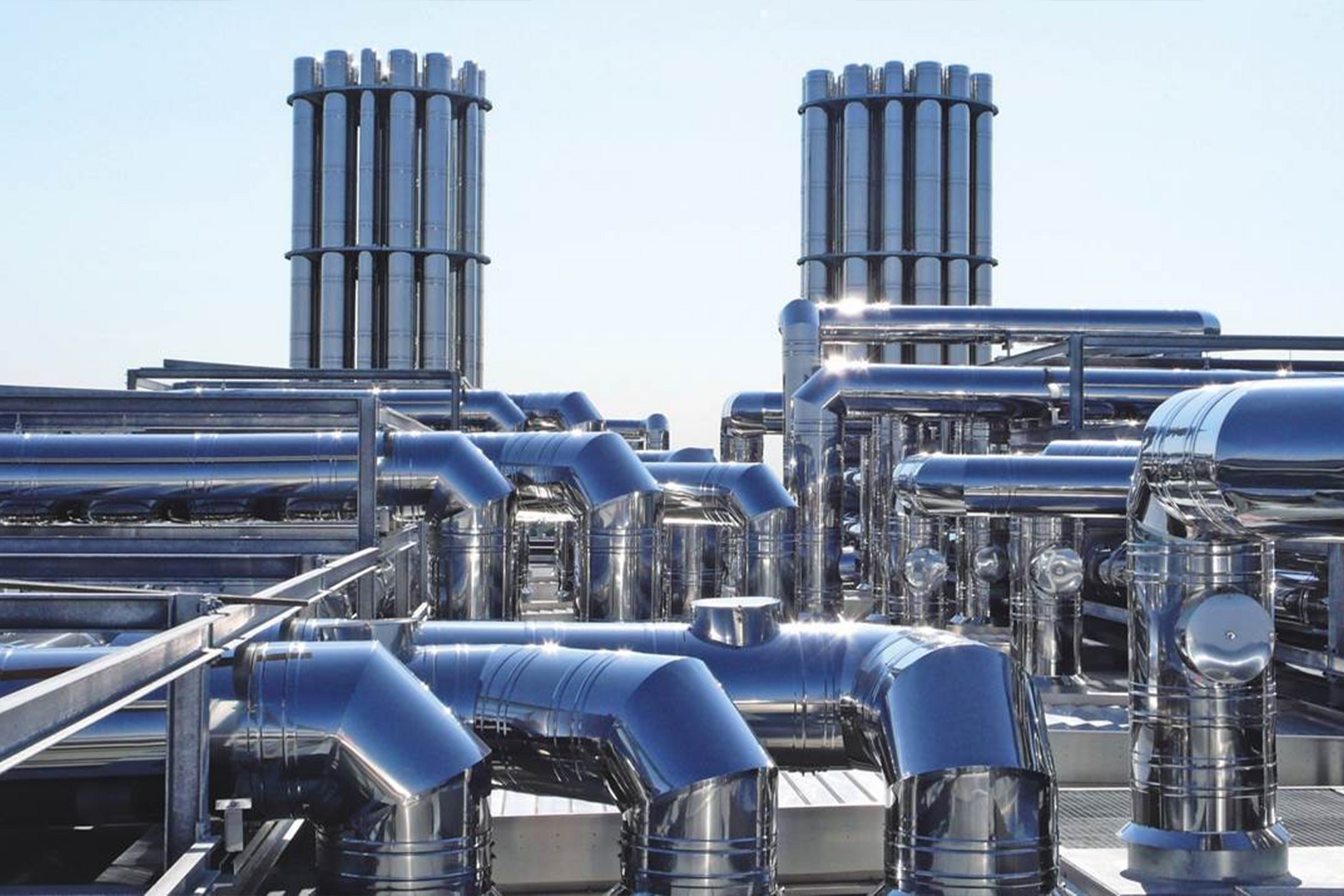
Draw a grease duct on a page and it looks like a single continuous thing: a line running from the hood collar, across the ceiling cavity, up a chase, out through the roof. One element. One line weight. One entry in the schedule.